Conference Summary: THE SCIENCE OF TEACHING DURING A PANDEMIC

I am a lucky fellow: I got to attend the online conference “THE SCIENCE OF TEACHING DURING A PANDEMIC: Creating Motivated, Focused, Active, Autonomous Learners” organized by Learning & the Brain . I’ll start with an admission: I loved going to academic conferences, and I hope to get to travel to in-person conferences again someday. An all day virtual conference didn’t appeal to me, but the line up of speakers at this conference was too good to pass up. This conference turned me into a believer: I think I may have learned more at this one day virtual conference than I have at multi-day in person conferences. I expect it would have been even more powerful in person, but Zooming in to these talks was unexpectedly effective and fun. I’m a believer, and I hope the virtual format allows more people to attend conferences like this one. 

This blog post is an attempt at a summary of the conference highlights for me, and I’m sharing it in case it’s useful for someone who isn’t as lucky as I am and couldn’t attend this conference. For those of you who want the complete summary, here are my notes (warning: I editorialize!) 
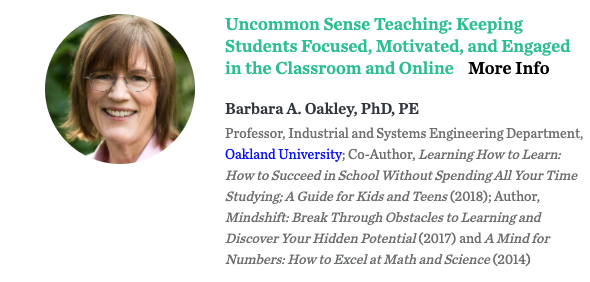
8:00 Keynote: Uncommon Sense Teaching: Keeping Students Focused, Motivated, and Engaged in the Classroom and Online – B. Oakley

  • I’m cautious whenever anyone in education/teaching research tries to use brain research (there are SO MANY examples of overgeneralizations of brain research in education advice) but Dr. Oakley is definitely the real deal. She uses brain research cautiously and precisely, as far as I can tell. 
  • Her “Neuron as space alien” idea is super cute and useful. 
  • The discussion of Dopamine’s role in learning was new to me. Dopamine allows the stimulus response conditioning (positive reinforcement). Parent excitement can be a reward for a baby – dopamine allows that reward system to work. You only get a dopamine hit if learners don’t EXPECT the rewards. No dopamine increase for an expected reward (related to the mouse research on latent learning?). An unexpected reward = dopamine boost which strengthens the connection (long term potentiation?) This finding may have implications for how we use rewards, etc. for student motivation (I’m interested in thinking about how this connects with the advice in Peps Mccrea’s new book Motivated Teaching). 
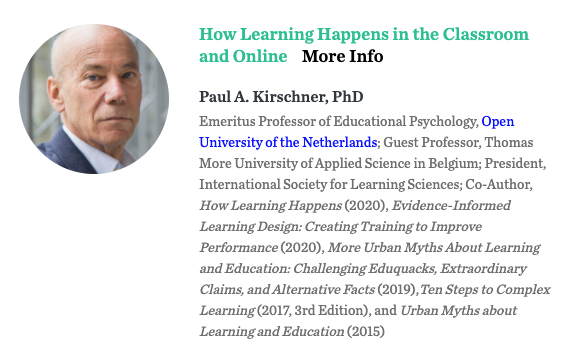
9:10 Keynote: How Learning Happens in the Classroom and Online – Paul A. Kirschner

  • Dr. Kirschner is a “pull no punches” kind of writer/speaker, and I’m excited to hear his clear, direct advice. He helped me before with a learning equation
  • “Please close your WMDs – weapons of mass distraction” 
  • Dr. Kirschner discussed research about “Advance organizers” – I’m interested in checking that research to see what might be useful for teachers in my district. 
  • He asked a tough question:
    • What’s the most powerful influence on learning?
  1. The teacher
  2. The teaching method
  3. Student prior knowledge
  4. Learner motivation
  • The answer to this question (3! Prior knowledge!) relates to Assimilation/Subsumption theory: new information is linked and assimilated into already existing knowledge. Meaningful learning = constructing meaning from new information (Connections to constructivism! Dewey!) Learning depends on information processing.
  • Then we got to go on a great, concise tour of learning/memory theories: Information processing (Atkinson and Shiffrin), Baddeley (Central executive, PL and VSS), Sweller Cognitive Load theory, Pavio Dual Coding theory, Mayer’s cog theory of multimedia 
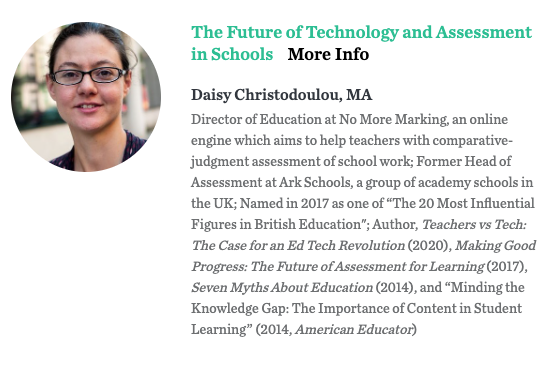
10:20 Option 5 (K-12): The Future of Technology and Assessment in Schools – Christodoulou

  • Dr. Christodoulou just published a book about technology and teaching. I haven’t read it yet so I was especially excited to get a preview.
  • In her book, she tries to figure out what these terms/ideas actually mean: personalization, online content, active learning, screen based learning. I loved how she talked about these issues. She imagined a “contiuuum” for each idea and described the ends of each continuum. The bottom end = “not effective for learning” and the top end = “Effective for learning.”
    • Personalization: not effective end = learning style. Effective end = adaptive learning
    • Online content: not effective end = “you don’t need to teach anything that you can google”, Effective end = Multimedia learning (Mayer’s principles) 
    • Active learning: Not effective end = “learn by doing” (what students are THINKING about is the important thing, not what they are physically doing). Effective end: learn by quizzing
    • Screen based learning: less effective = all purpose devices (can be really distracting). More effective: dumber devices (using app blockers) (e.g. one laptop per child didn’t work)
  • I love this approach. Talking about the continuum instead of binary right/wrong ideas is much more useful and realistic
  • She also talked about the Comparative Judgment technique. This was a great reminder of something I learned about a while ago, and I was so motivated that I signed up for one of her free Comparative Judgment webinars and I’m trying to figure out how this idea might be useful with some social studies assessments in my district.  
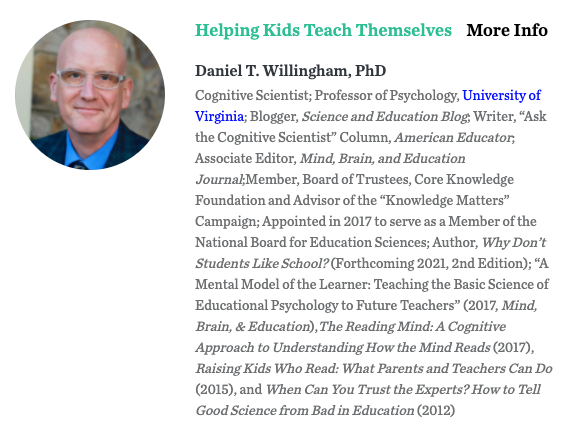
11:50 Keynote Option 1: Helping Kids Teach Themselves) Willingham

  • I think Dr. Willingham is one of the best science communicators out there, and I appreciate all his work trying to clearly summarize what psychology research can tell us about teaching and learning. He’s great. 
  • In this talk, he synthesized research about why students procrastinate, how to use research about selective attention, studying methods, and checks for understanding/questioning techniques to overcome procrastination and other learning obstacles.
  • Overall: he may be our best “research summarizer” in education. We need more of this kind of overall synthesis and then we need to act on it. When we want to try something new, we shouldn’t start from the beginning. We need solid ground to stand on.
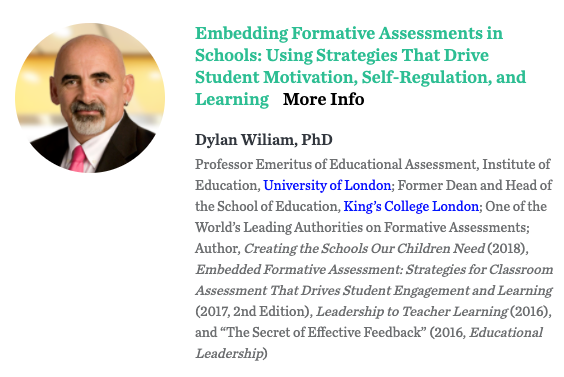
1:00 Option 5 (All Grades): Embedded Formative Assessments in Schools: Using Strategies that Drive Student Motivation, Self-Regulation, and Learning – Dylan Wiliam

  • Dylan Wiliam is so good at starting with clear definitions and working from there to logical conclusions based on research. 
  • If we define earning as a change in long term memory (makes sense!) then we have to remember that this is a LONG term process. If we forget it in a week, it wasn’t learning. We should reserve the word learning for a relatively long term change in LTM. 
  • Teaching takes place in time, learning takes place over time
  • I love this definition of assessment: a device for drawing inferences or conclusions. That definition clarifies some muddy waters (like the horribly abused terms formative and summative assessment!) 
  • Love this quote: “The only important thing about feedback is what students do with it.”
  • “None of Hattie’s effect sizes make any sense”  – damn! Shots fired!

There were many other talks I would have loved to hear: Steve Chew! David Daniel! James Lang! Richard Mayer! It was a great conference, and if anyone wants to talk about any of these ideas, please holler! 
Bias: two studies and some thoughts

I stumbled across a couple studies related to bias and schools recently, and they got me thinking.

Study #1: Quinn, D. M. (2020). Experimental Evidence on Teachers’ Racial Bias in Student Evaluation: The Role of Grading Scales. Educational Evaluation and Policy Analysis , 42, 375-392.

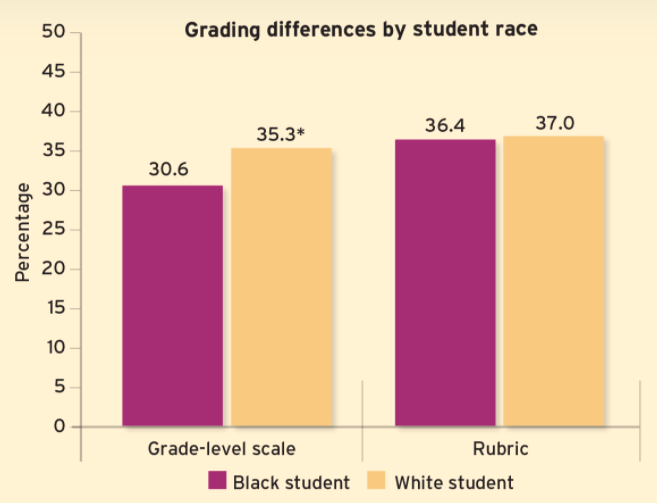
In this study, Quinn looked at the scores teachers gave students on samples of their writing. His findings show evidence of racial bias overall, but this bias disappeared (mostly) when teachers used a rubric when scoring. Here’s a good summary of the study written by Quinn, and this graph represents the main results well:

One surprising (and potentially important) finding is what Quinn did NOT find. He had participating teachers take the IAT test for implicit racial bias. He found no relationship between scores on this implicit bias test and the grading differences he measured. This finding (and other criticism about predictive validity and the IAT test) makes me wonder if the time spent discussing implicit bias in schools is worth it? And maybe I should retire this “live” implicit associations test demonstration? Maybe we should spend our time talking about how to mitigate the influence of bias in our teaching (with techniques like using rubrics) instead of analyzing our possible implicit biases?

Study #2: Francis, D.V., Oliveira, A.C.M. De, Dimmitt, C. (2019). Do School Counselors Exhibit Bias in Recommending Students for Advanced Coursework? The B.E. Journal of Economic Analysis and Policy, 19(4), 1-17.

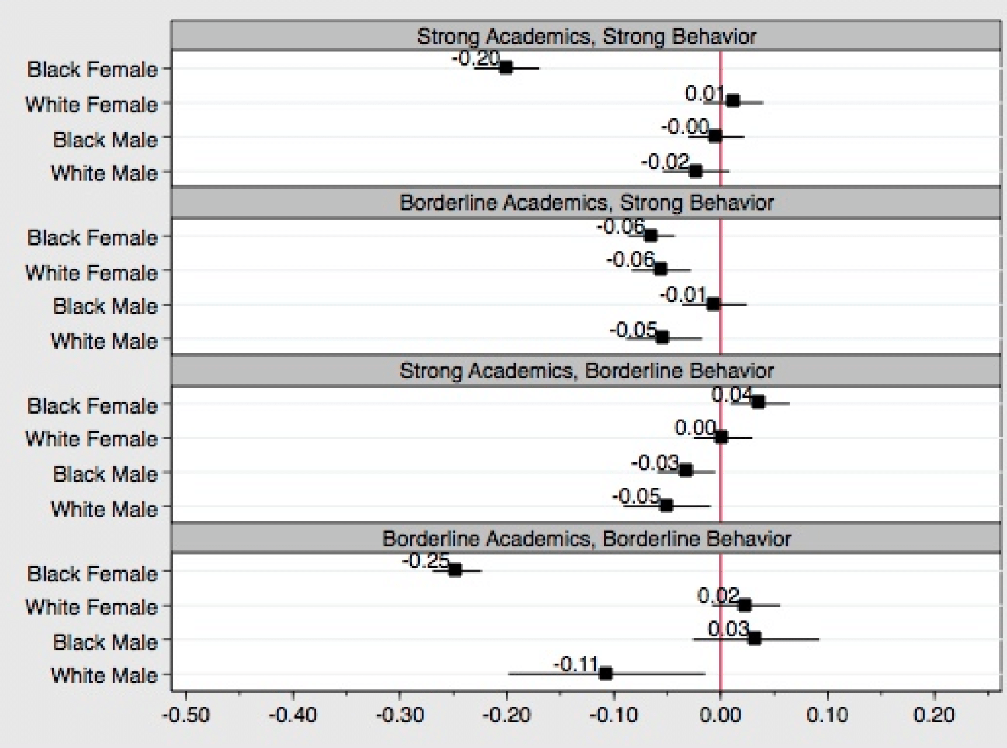
This study could start useful discussions in every high school with AP and IB courses. Here’s a quick summary. The authors use a clever methodology to investigate whether high school counselors may unintentionally be influenced by their biases when recommending students for advanced courses. Many people are familiar with the well-established finding that job resumes that include names that employers interpret as “black” names are less likely to result in calls for interviews than resumes with names that employers interpret as “white.” Francis, Oliveira, and Dimmitt used this same technique with “student resumes” and high school counselors. High school counselors judged student records and made recommendations about whether students should be allowed to enroll in an AP Calculus class. This figure represents one of their most important findings:

The authors describe their main conclusion: “… black female students are uniquely disadvantaged. School counselors are significantly less likely to recommend them for AP Calculus in both the weakest and strongest profile scenarios. In fact, the black female transcript in the strongest academic and behavioral profile was equally as likely to be recommended for AP Calculus as the blinded profile in the weakest academic and behavioral profile.” This clever study about bias could be used by high school counselors and school/district administrators as a starting place for potentially important discussions about how race and gender bias may be influencing academic opportunities for students.

UPDATE: My friend Josh shared these two citations with me (thanks Josh!) Based on the abstracts, I think they may be useful in this overall discussion:

Copur-Gencturk, Y., Thacker, I. & Quinn, D. K-8 Teachers’ Overall and Gender-Specific Beliefs About Mathematical AptitudeInt J of Sci and Math Educ (2020). https://doi.org/10.1007/s10763-020-10104-7

Copur-Gencturk Y, Cimpian JR, Lubienski ST, Thacker I. Teachers’ Bias Against the Mathematical Ability of Female, Black, and Hispanic Students. Educational Researcher. 2020;49(1):30-43. doi:10.3102/0013189X19890577

Praise for Caste by Isabel Wilkerson

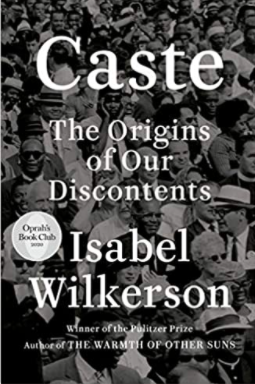
I think this is the first time I’ve posted about one specific book, but I just finished Caste by Isabel Wilkerson and I feel moved to talk about it. I think this is an amazing and important book, and I hope that sharing some thoughts might encourage others to read it.

I approached this book with apprehension because I knew I would be reading about atrocities and this wouldn’t be a comfortable or pleasant read. And I was right: the violent historical and current events Wilkerson describes are hard to read and think about. But this discomfort is deliberate and effective. Wilkerson doesn’t avoid or turn away from any of the realities she describes, and I think her scholarship and documentation are excellent (note: I’m not a historian and I don’t have the background knowledge to evaluate her historical scholarship, so I would like to read more historians talk about her work).

Wilkerson convinced me of her main (I think) premise: it is useful to think about the United States as a caste system (in the same context as the caste system in India and the caste system the Nazi’s established before WWII). I’ve been involved in many discussions that get stuck as the group tries to define what racism means (and doesn’t mean), and what exactly systemic racism means (contrasted with personal acts of racism, or racist attitudes, etc.) Thinking about the US as having a caste system based on race since before the beginning of our country can help cut through some potentially “wheel-spinning” discussions about definitions of racism and allow a group to get to productive discussions about what happened and is happening in the US (and maybe what to do about it).

Here is a somewhat random list of other details from the book that jumped out at me:

  • Pg. 231 – I had no idea about the history of the idea and practice of vaccination, and how that story intersects with US history! (here’s the reference Wilkerson provides)
  • Pg. 251 – Wilkerson describes the AMAZINGLY brave research done by Davis and the Gardners – Deep South: A Social Anthropological Study of Caste and Class – I’m anxious to read more about that study and their recommendations.
  • Pg. 283 – this quote floored me: “Knowledge without wisdom is adequate for the powerful, but wisdom is essential for the survival of the subordinate.” (Wilkerson quoting Patricia Hill Collins)
  • Pg. 385 – check out the big brain on A. Einstein! I’ve never read about his thoughts on civil rights before: “We must make every effort [to ensure] that the pas injustice, violence, and economic discrimination will be made known to the people… The taboo ‘let’s not talk about it’ must be broken. It must be pointed out time and again that the exclusion of a large part of the colored population from active civil rights by the common practices is a slap in the face of the constitution of the nation.”

AP Psychology Self-Study Plan

Many (all?) AP Psychology teachers are dealing with near constant pandemic related interruptions this year, so there is a high level of concern about getting students ready for the AP Psychology test. Here’s what we know about from College Board what the test will look like (I think this is the most recent information, but I could be wrong):

From the College Board AP Psychology Discussion Board

“2021 AP Exams will cover the full scope of course content and skills.:” 

An updated testing schedule with two contingency testing dates for each subject—one in the second half of May and one in the first half of June—will support schools that want more instructional time before testing. Exams on the contingency dates will also be full length, covering the full scope of course content.

  • Full-length digital contingency exams can be taken at home, if authorized by the AP coordinator, in the event that a school is closed or coronavirus-related risks prevent a student from testing at a school.” 

More Information in February – The exam schedule and information about the contingency testing options will be posted to AP Central® in early February, and announced via email to AP teachers, AP coordinators, and administrators.” 

Now that we know that all the units in the AP Psychology CED will be assessed on the AP Psych test, this puts Psychology teachers in a bit of a pickle. How can teachers “cover” all the units this year with very limited instructional time? Given the interruptions so many AP Psych teachers are experiencing, it might be useful to figure out a way students can “cover” a chapter or unit on their own. This “self-study” idea can help students prepare for the test AND it can free up some time in AP Psych teachers pacing/instructional calendars. 

Full disclosure: 

  • This plan will work better for some students than others. Students who are already “self-regulated learners” (short summary on pg. 15 in this Andrade/Brookhart article ) will have an easier time following a plan like this one than other students. All students, especially students whose self-regulation skills aren’t strong yet, would learn better from you in your classroom (and it would be a heck of a lot more fun). But that’s not the situation you and your students are stuck with this year: students need to get ready for a full AP exam that covers all the units, and you only have so much time you get to be with your students. 
  • I include recommendations for a couple non-free resources that I co-authored in this plan.

Here’s an plan about how to help students “cover” some content they will need for the AP Psych test on their own (without adding a bunch of work to your already too-long to do list!)

Short list of the steps in the self-study plan: 

  1. Pick a chapter you think students might be able to learn on their own. 
  2. Find an overview you think students can handle
  3. Have students test themselves using AP-style multiple choice questions BEFORE they study the chapter in depth
  4. Students study a more detailed source with information about relevant concepts
  5. Have students test themselves again using AP-style multiple choice questions AFTER their in-depth studying 
  6. Finish their self-study by creating a list of the most important terms from the chapter and create their own examples for each term 

More detail about each of these steps: 

  1. Pick a  chapter. Look at your plans for the rest of the year and pick a chapter from one of the units that you think your students might be able to “cover” on their own. My suggestions: states of consciousness, motivation/emotion, the thinking/language part of the cognition chapter, personality, or intelligence. These are important chapters (and there will be some items on the AP exam devoted to content from these chapters), but they are somewhat “discrete.” Understanding content from these chapters doesn’t depend on understanding concepts from other chapters, and they are concise enough that students might be able to tackle them on their own
  1. Choose a good “introduction” for students. It will help students to get an overview of content about the chapter without you having to make a video, write an overview, etc. A pre-made video might work well as an overview. The Crash Course psychology series is high quality, and these videos move fast. If there is a video on AP Classroom already made and released for the chapter you chose, that might work well too. Students should watch the video to a “big picture” overview of what this chapter is all about. Some AP Psych teachers already made some EdPuzzle and other resources for some of these videos that might be useful for students to complete after watching the video (go to EdPuzzle and search for Crash Course Psychology). 
  1. Test yourself, version 1:  Students should try to answer the multiple choice questions at the end of the chapter in the test prep book and the textbook they are using for your class. Yes, they should try to answer these questions BEFORE they do in-depth studying of the content. Trying to answer these questions will help set them up for success when they try to learn the material (see relevant research in Make it Stick)  Let them know that it doesn’t matter if they get the questions right or wrong at this point – what matters is that they try to answer the questions, check their answer, and THINK THROUGH why the right answers are right and the wrong answers are wrong. They want to get a sense of what multiple choice items are like from this chapter. 
  1. Dive in: read and take notes. Reading and taking notes from the textbook students are using for you class might work, but sometimes this amount of reading and information is overwhelming for some students. It might be a good idea for students to start with the shorter summary of the chapter they can find in an AP test-prep book. There are several good test-prep books. Allyson Weseley and I tried to summarize the relevant concepts from each AP Psych chapter in our book Barron’s AP Psychology. These chapters are about 15-20 pages long, and students should be able to work their way through these summaries and take notes on the concepts listed in that chapter. Instruct students to write EXAMPLES of each concept – examples will help them more than definitions. (The AMSCO/Perfection Learning book by Chuck Schallhorn might work well for this step too). 
  1. Test yourself, version 2: Now it’s time for students to really do some retrieval practice. They should to figure out what concepts they’ve encoded into their long term memories and what they still need to think about in more detail. I think the best set of items for them to use is from the book Kristin Whitlock and I wrote: Barron’s AP Psychology Q&A. This book has 600 brand-new AP Psychology items written in the AP Psychology exam item format. Each chapter has about 50 items, and students can use this set of items to test themselves to see what concepts they “get” and which concepts they need to go back and read about more. The questions are purposely written in different categories (research methods, scenarios, perspectives, etc.) and students will get a wide range of practice answering them. 
  1. Final step, write out your own examples: At this point in their process, students should be able to make a list of the important concepts from the chapter (the “key terms” list from the textbook they use for your class or the terms listed in the test-prep book will work). By each of those terms, students should be able to write out their own example of that term (and if they can figure out how to apply the term to their own lives, that’s even better! Self reference effect!) If students can do this, they are probably ready to go! 

Again, this process will probably work best for students who are already motivated (self-regulated learners), but any student who gets through at least some of the steps will benefit, and getting students to do a self-study plan like this one may help relieve some of the pacing pressure facing AP Psychology teachers. Good luck out there! Hope this is useful! 

Dynamic Drawing Example: Operant Conditioning

I received some feedback about my Dynamic Drawing post recommending that I provide a more fleshed-out example of how I might use the idea in a classroom. Around the same time, a psychology teacher-buddy (hi Winnie!) asked me to make a video for her class. So I decided to combine the projects!

I made this set of slides for my friend: Operant Conditioning diagrams. Here’s how I might use them in a high school psychology class:

  1. Slide 2 and 3: I want students to know that there are 4 kinds of operant conditioning, and it can be a bit tricky to keep them straight.
  2. Slide 4: one scheme that can help prevent confusion is to associate the word “positive” with “+” or addition and “negative” with “-” or subtraction If students associate the words positive with “good” and negative with “bad,” that will end up causing them trouble later on.
  3. Slide 5: students should associate the term “reinforcement” with an organism repeating a response and “punishment” with an organism NOT repeating a response. This will be more helpful than thinking about a reinforcement as a reward (or something “good”). Keeping the focus on whether the response, the behavior, is repeated or not will be important later.
  4. Slides 6 and 7: these are “dynamic drawing” videos that walk students through simple “sequence” and “matrix” diagrams that can help them figure out examples of operant conditioning. If students can draw these diagrams for themselves on a blank sheet of paper, the diagrams can be useful if they are asked to unpack an operant conditioning example. Modeling how to draw these diagrams might help students learn how to draw them on their own.
  5. Slides 8 through 11: this is a good opportunity to emphasize that knowing how the organism responds after the stimulus (the “R2” in the sequence diagram) is absolutely essential. If we don’t know how they organism responds, there is no way we can figure out what kind of operant conditioning occurred!

Here’s the video from slide 6 – the sequence diagram:

Source: https://drive.google.com/file/d/1DDvN0gJn7mZGUHF1ZgzCzU1YPq4rneaH/view?usp=sharing

Here’s the video from slide 7 – the matrix diagram:

Source: https://drive.google.com/file/d/1xRbgHGIKlr7vOye7gqC8EdP723yqEi_3/view?usp=sharing

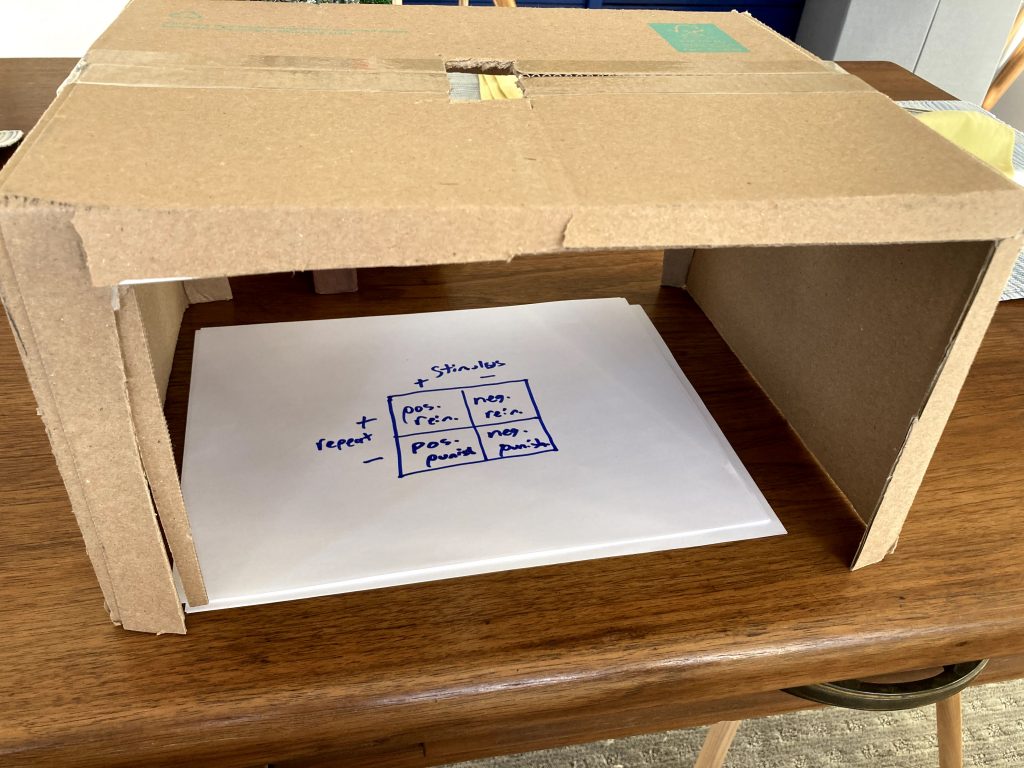
My friend said she planned on using these videos with her high school psychology class, so I hope to get some real feedback from students about how useful these videos and diagrams are. By the way, if any of you want to make similar videos, here’s the very complicated “filming rig” I made out of a cardboard box (I put my cellphone on top with the camera pointing down through the hole).

Dynamic Drawing

Source: https://www.youtube.com/watch?v=16SBht2iF_k

When my school district had to shut down suddenly last Spring because of the pandemic, I got to talk with several teachers about the sudden transition to online teaching. One of the most frequent comments I heard was “I miss my white board!” 

I can relate to that feeling. I often use a white board when I teach, but I never thought deeply about the role of the white board in teaching before the pandemic. White boards are so ubiquitous, they are always just “there,” and I took them for granted. When we were suddenly restricted to just what we can share with our camera and screen sharing, I started to think about the teaching value of white boards. 

As I thought and read a bit, I stumbled across the “Dynamic Drawing Principle.” The term refers to a teacher presentation choice: when a teacher draws or writes “live” in front of students (on a board, on paper via a document camera, etc.) rather than just showing something “finished” on a slide. This blog post about making effective instructional videos provides great advice overall, and mentions the dynamic drawing principle (good example of dynamic drawing at about 2:35 in the video embedded in the blog). If you’re looking for quick advice, Blake Harvard summarizes advice from that blog post effectively. This journal article found evidence supporting the idea that for some lessons, dynamic drawing helped students learn from a pre-recorded lecture about human biology. I think the best and most complete example comes from this fantastic ResearchEd video by Adam Boxer: the video starts rather abruptly with an extended example of dynamic drawing, and then transitions to a fabulous explanation of how dynamic drawing might help the learning process using current cognitive science principles (and he continues to use dynamic drawing throughout the video to help viewers understand the connections to memory theory, etc.) 

Why might dynamic drawing be a big deal? If you are making videos to help people learn, you may want to look through the resources linked above to see when drawing and writing “live” in the video might help people learn. If you are able to teach students face to face in a classroom, thinking through the dynamic drawing principle can help make deliberate instructional choices: when do we want to use a static slide as we teach? When do we NOT want a slide because we instead want/need to draw and write on the board to demonstrate an idea? 

I worry that the term Dynamic Drawing may cause some people to think that this idea is specific to “drawing.” Several of the examples above include writing words/numbers “live” for students while teaching. It’s not about drawing images, words, or numbers. I think the powerful learning element in dynamic drawing might be seeing a visual representation of an idea “appear” as a teacher writes it on a board, piece of paper, etc. instead of seeing a finished product. It’s possible that seeing an idea develop as a teacher draws/writes it helps our working memory focus on just the “right part” of the idea. Perhaps seeing the idea gradually unfold helps with selection attention and cognitive load? I’m excited to read more research and see teachers’ examples of the power of dynamic drawing.

I’m also trying to think about when I might use the dynamic drawing principle in the classroom. Three thoughts: 

– Thought #1 – a Process: if I want to show a process, I think dynamic drawing might work better than a static slide. You can add animations to a slide, but I always end up pointing at the animation anyway, and often the animation plays faster or slower than I want it to. Drawing the process on the board or document camera would provide a lot more control. My textbook had professionally drawn images of the classical conditioning process, but I always chose to diagram examples of classical conditioning on the board instead. There was something about labelling each part of the diagram in front of students that helped us all think through the process together at a useful pace.

– Thought #2 – a Reveal: sometimes you want to emphasize a term or element of a problem/concept, and the dynamic drawing principle could help with a dramatic “reveal” that could emphasize importance, etc. to students. There’s no digital substitute for a dramatically drawn huge arrow or circle for the key part of the answer to a question, etc. When I taught the history of psychology, I loved the dramatic reveal that my alma mater, the University of Nebraska, was (for a time) one of the top three most important colleges for psychology research and majors.

– Thought #3 – using a Diagram: when I taught introductory psychology, there were several diagrams that helped students understand tough concepts, and I often wanted to make sure students could draw these diagrams themselves. Drawing these diagrams in front of students on the board was a good scaffold to help them draw their own diagram later. Teaching the differences between positive/negative reinforcement/punishment is tricky, but helping students learn to draw their own 2 by 2 grid helps a lot.

I would love to hear from some of you about what you think of the dynamic drawing principle and your examples from your classrooms. Draw on!

The world’s best 24 minute video for teachers and administrators

Source: https://www.youtube.com/watch?v=XOKG2LrnwYo

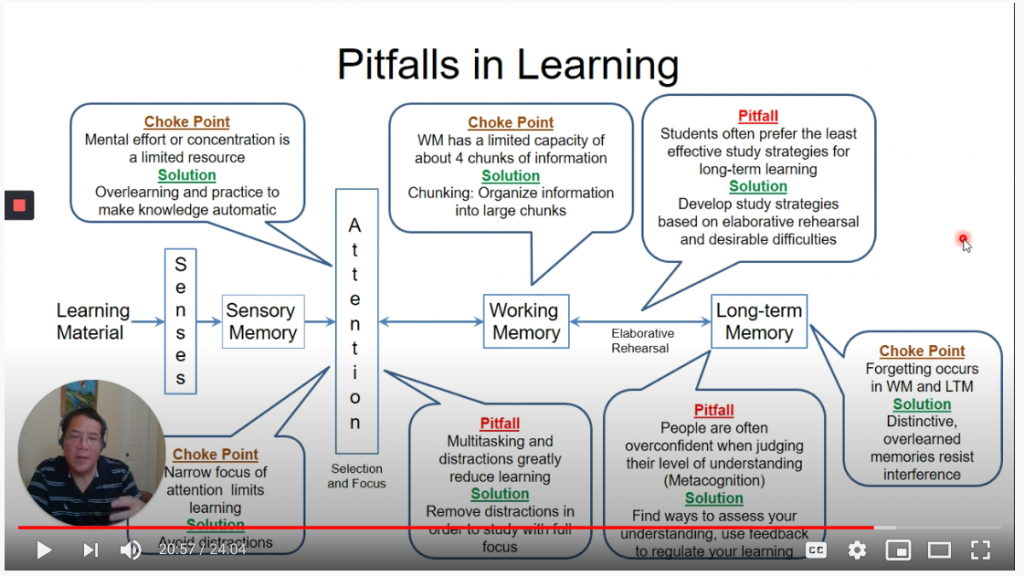
I’ve written about Stephen Chew‘s great work before (“9 little things: teaching and learning are complicated,”) but this video from Dr. Chew is so important that it’s worth a separate blog post. This is a bold statement, but I think it might be the most useful, information-packed 24 minutes of learning teachers and administrators can find on the internet (or anywhere!)

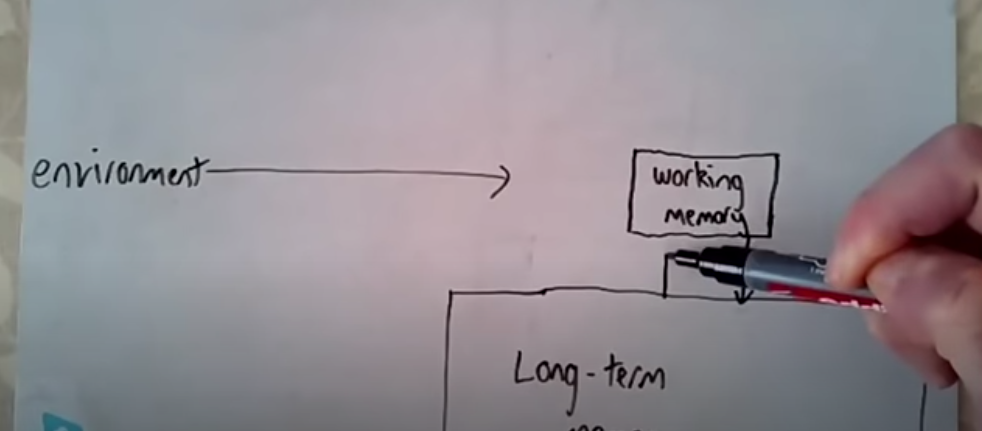
Dr. Chew calls this video “Learning in Pandemic Times,” but the information isn’t specific to remote teaching or other aspects of teaching during the Covid19 pandemic. In the video, Dr. Chew walks us through the most useful and research supported cognitive psychology model of memory, and clearly explains how different aspects of this model relates to teaching and learning. I’ve written about this model before (“The 3 Box Memory Model and Teaching/Learning,”) but Dr. Chew does something unique and incredibly useful with the model in this video.

The innovation in this video involves what Dr. Chew calls “Choke Points” and “Pitfalls.” As he walks us through the model, he identifies “choke points,” or limitations in our memory system that create constraints or restrictions in what we learn. At every step, he explains the relevant choke point and offers a practical suggestion about how students can overcome this limitation. He also identifies “Pitfalls,” which are common mistakes people make when trying to learn. These are common studying techniques, etc. that work against our learning because they aren’t aligned with the way human memory works.

I encourage EVERYONE who is interested in teaching and learning to watch this 24 minute video. Teachers and administrators will get a clear and practical overview of how the cognitive psychology model of memory relates to how we do our jobs. As Dr. Chew says at the beginning of the video: “Learning only takes place in one location, and that’s inside your brain.” If we start with this principle and this model of memory and learning, we can focus our efforts and help students learn in more efficient and useful ways.

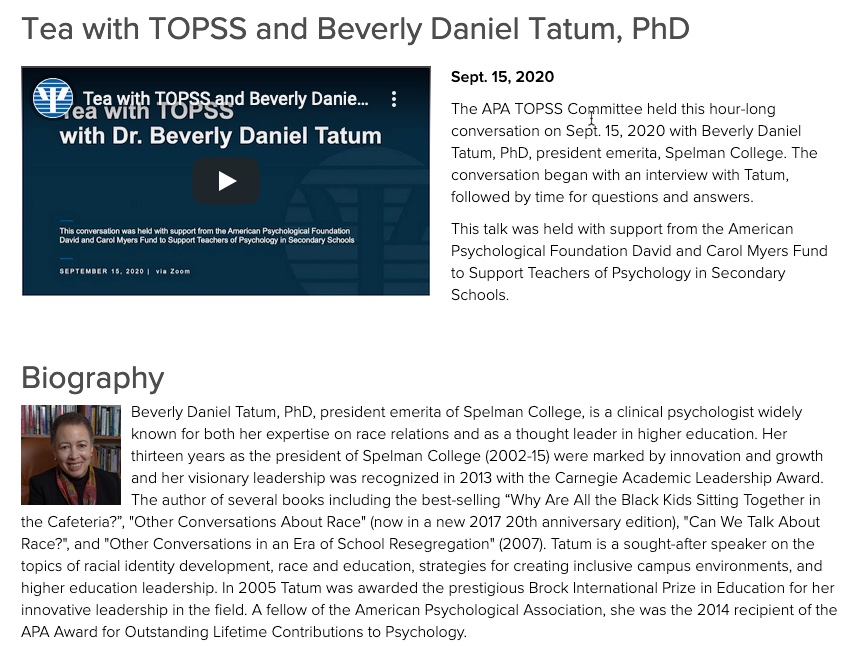
Tea with TOPSS: Dr. Beverly Tatum

https://www.apa.org/ed/precollege/topss/virtual-conversations

I think the Teachers of Psychology in Secondary Schools (TOPSS) is the most valuable professional organization I belong to. They consistently develop and share high quality materials that I find incredibly useful.

Here’s the latest example: “Tea with TOPSS and Beverly Daniel Tatum, PhD” 

The good folks at TOPSS found funding (thanks D. Myers!) to set up and run several Zoom conversations with psychological researchers. This conversation with Dr. Beverly Daniel Tatum is my favorite in the series so far. Dr. Tatum is the author of several amazing books about her research, including Why Are All the Black Kids Sitting Together in the Cafeteria? During this hour-long chat, Dr. Tatum shares details from her research and academic work on race and racial identity and does a great job helping high school psychology teachers think about how this research might be relevant in their classes and for their students.

Dr. Tatum is REALLY good at using analogies to help students understand how to think about complicated constructs like racial identity and racism. Here are three of my favorite analogies she used: 

Group Photo: imagine you are a participant in a large group, and the group gets a group photo taken. When you get your copy of the photo, what is the first thing you do? The first thing you look for is yourself. You try to find yourself in the photo to see how you look. If you can’t find yourself, your initial question might be “What’s wrong with this picture?” But when it happens several times, you start asking “What’s wrong with me and people like me? How come we’re never in the picture?” Representation matters: make sure everyone seems themselves in the picture and that they look good.

Breathing Smog: in our culture, there are SO many stereotypes and sources of misinformation about race. These stereotypes are so pervasive that they are in some ways like “smog.” Smog is air pollution that is ubiquitous and widespread across an entire community. We all just have to admit that we’ve all been smog breathers. We’ve all been influenced by these ambient cultural stereotypes (see “implicit bias.”) If you live in a community with smog, you end up breathing smog sometimes. And we have to admit that sometimes we breathe OUT some smog. We say or do things that are influenced by the ambient cultural stereotypes, even on an nonconscious level. Teachers can use this analogy with students, We can say “When I breathe out smog, please point it out to me. There’s so much out there that it’s easy to miss, so please let me know. We all want to reduce the amount of smog out there. Our collective goal is to clean up the air.” If someone breathes out some smog in your classroom, you can establish a norm that helps everyone non-confrontationally note that (maybe with the word “ouch”). Acknowledge that this is likely to happen during discussions about race, and establish a norm to help everyone deal with it.

The Racism Walkway: racism is best thought of as individual acts (rather than an internal disposition). Picture a moving walkway: ambient racism in a society is like a walkway that is moving in one direction, moving everyone along. Some people are committing acts of racism – that’s like running ahead deliberately on the walkway. Most people are just not acting, moving along as the walkway moves them (contributing to systemic racism through our passivity). But if we want to do an anti-racist act, if we want to work against systematic racism, then we have to be willing to TURN AROUND and walk in the opposite direction. That’s a bold and deliberate action.

And here’s an activity she used during her talk that I think might work well in any high school class:

Earliest Race Memory: what is your earliest memory of learning about race, or becoming aware of race? What did that feel like? Did you talk with anyone about it? Usually people don’t – we internalize early on that you’re not supposed to talk about race. We get a lot of practice at NOT talking about race, and that makes it tough to get conversations going. You can’t solve problems that you can’t talk about. This also causes anxiety: we get nervous when we start talking about race, and that makes everything harder. We need to be willing to push past our anxiety and discomfort about talking about race.

THANKS to Dr. Tatum and to TOPSS for creating this great opportunity to learn from a thoughtful, humane scholar. 

What should teachers know about the brain?

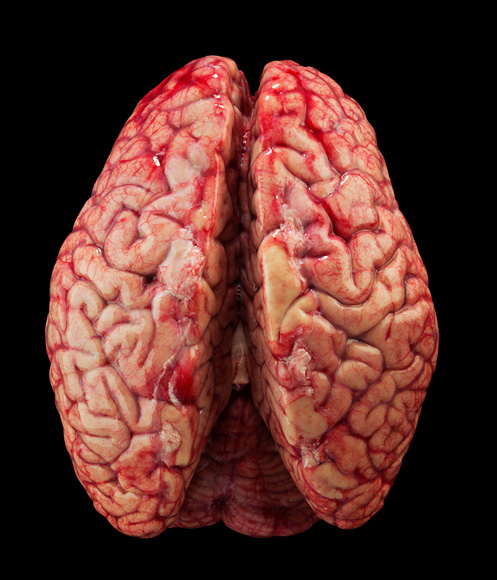
https://okyanusum.com/en/wp-content/uploads/2014/02/mercek.1.1.jpg (creative commons)

When I taught psychology to high school students, I LOVED teaching them about the brain. I loved sharing the amazing details about this most amazing object in the universe that they carry around with them in their skulls. I loved sharing brain research with them – students often told me that the time we spent talking about Gazzaniga and the split-brain patients were a highlight of the class. I love reading about contemporary brain research (although I often suspect that I don’t have the background knowledge needed to evaluate some of the claims in the sources I’m reading). 

Given my love of brain research and my love of teaching, I am also interested in a related topic: What should teachers know about the brain? So far, what I’m learning surprises me a bit. 

Daniel Willingham and David Daniel tackle this question head on in one of their “The Daniels” video blogs (which are all a lot of fun, by the way. Daniel Willingham and David Daniel. Get it?) In this short video, they effectively discuss a 2013 Educational Researcher article called “Infusing Neuroscience into Teacher Professional development.” The Daniels conclude that the article doesn’t have much to say about whether brain research is truly “actionable” by teachers. Teachers can definitely learn about brain research, but does it actually help teachers make decisions? They conclude that the answer (so far) is no. For example, knowing that speech is controlled by two specific areas in the left hemisphere of the cerebral cortex is fascinating for all sorts of reasons (check out that Gazziniga split-brain research I mentioned earlier!) , but it doesn’t help me decide how to teach reading, or speech, or anything else.

https://www.youtube.com/watch?v=KDz8JWbHnK8

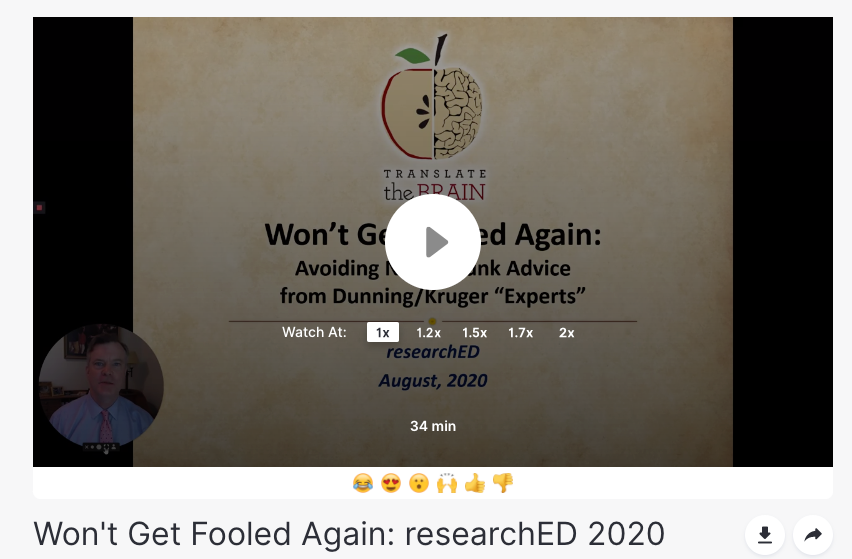
Andrew Watson tackles a similar question in his great ResearchEd video “Won’t get Fooled Again.” About 17 minutes into the video, he describes a scenario in which a presenter helps teachers understand neural anatomy and the process of neural transmission (another one of my favorite topics in my high school psychology class. We even took a field trip to the bathroom!) After the fictional staff development is over, he wonders what would happen if one of the teachers asked: “Now that I know some information about the brain, how should I use that information to make teaching decisions?” The answer is: you can’t. There are all sorts of great reasons to learn about neural anatomy and function, but this knowledge doesn’t help us make teaching decisions. 

https://www.loom.com/share/74f2773fc34645d39713b8c8cd139ea5

And I was excited when I received my “Learning and the Brain” issue of Educational Leadership. I read through the articles eagerly, and gradually got more and more… perplexed. The articles were well written and researched, and I enjoyed learning some recent research about the brain. But I didn’t find discussions of how the brain research directly applied to teaching decisions (or when they did, the application suggestions were based on memory/cognitive/motivation research, not specifically brain research). The last two articles (Education’s Research Problem and Retrieval Practice: A Power Tool for Lasting Learning were very practical and useful, but the advice from those authors was not based on brain research). 

http://www.ascd.org/publications/educational-leadership/may20/vol77/num08/toc.aspx

So what should teachers know about the brain? Right now, my answer is “As much as they are interested in, but what you learn won’t be your most powerful tool for making teaching decisions.” Learning science/memory/cognition research is much more immediately applicable to decisions about teaching and learning (for example, see Stephen Chew’s excellent “Learning in Pandemic times” video.) 

BUT maybe this won’t be true forever! I got to talk (via Twitter) with a neuro/bio researcher who is writing about physiological research that may be developing into more effective/accurate models of memory and learning than some current models (thanks Erica Kleinknecht! ) Specifically, her essay “Labels on the Brain” is great reading. I’m not sure I have the background knowledge yet that I will need to evaluate the effectiveness of competing models, but I’m interested in learning! 

Face or No Face? The Image Principle

Image source: https://www.flickr.com/photos/oddsock/82545283 (labelled for reuse, Creative Commons) 

Recently Zoom announced a new feature: teachers can use their PowerPoint or Keynote slides as a background when they teach (or make videos) via Zoom. I talked with several teachers who are excited about this feature, and it made me wonder about an overall question: in an instructional video, is it a good idea if students can see the teacher’s face? Just about every video conference/recording platform (Loom, Zoom, Screencastify, etc.)  makes it possible to put a little box or window into a video to show the teacher’s “talking head.” But does seeing the teacher talking help make the video or video learning experience more effective? 

I did a little digging and quickly ran into the idea of the “Image Principle.” This principle states that “including an image of an instructor’s ‘talking head’ during a multimedia presentation doesn’t necessarily improve learning outcomes.” (Mayer, 2001). But that phrase “doesn’t necessarily improve learning” doesn’t necessarily help us much! As teachers, how should we decide whether to include our face in a video or not? 

One useful way to think about this might be to use Cognitive Load theory. Our working memory (where we do our conscious, effortful thinking) can only handle so many tasks at once. Mayer points out that one of our goals in our videos should be to help students use their limited working memory space in ways that help them learn – to help them manage cognitive load. This means that we want to reduce “extraneous” load (anything that might cause students to think about things that aren’t relevant to what they are trying to learn) and include elements that help with “germane load” (cognitive tasks that help students thinking about what they should be thinking about in order to learn). 

So the image principle might change our question: instead of “Should I include my face or not in a video?” a better question might be “When is seeing my face relevant or helpful to the thinking students need to do?” Most of the time, students probably don’t need to see us during a video: usually we want them thinking about the words or images in the video and seeing our face might be extraneous load. But sometimes seeing a teacher’s face might be germane: if we are trying to establish a relationship in an early video and get students thinking about who we are as a teacher (and maybe who they are as a student), seeing our talking head might be useful. Or maybe we want to emphasize a specific point using our hands or other nonverbal expressions that are only possible with our face. It’s possible that occasionally including our face in a video could be used for emphasizing a vital issue, or an emotional connection with the material, or to get students’ selective attention focused on a specific point. 

I’ve heard and read advice for teachers similar to “always include your face in a video because it helps the students focus on your words.” Like most things in education, the reality is more complicated than these simple rules and advice imply. 

References: 

Centre for Education Statistics and Evaluation (2011) “Cognitive load theory in practice: Examples for the classroom” https://www.cese.nsw.gov.au//images/stories/PDF/Cognitive_load_theory_practice_guide_AA.pdf 

Christodoulou (2020 “What does the research say about designing video lessons?” blog posted on 30-04-2020, https://daisychristodoulou.com/2020/04/what-does-the-research-say-about-designing-video-lessons/ 

Mayer, R. E. (2001). Multimedia learning. Cambridge: Cambridge University Press. Summary: https://ctl.wiley.com/principles-of-multimedia-learning/