Many of my classroom teacher friends are moving to online instruction right now, and they are working REALLY hard to try to figure out how to make teaching and learning online work well for students. I’ve seen dozens of articles about what online systems might work well, overall guides about online teaching and learning, and I’m grateful that many organizations are producing these guides for teachers trying to make these changes quickly and effectively.
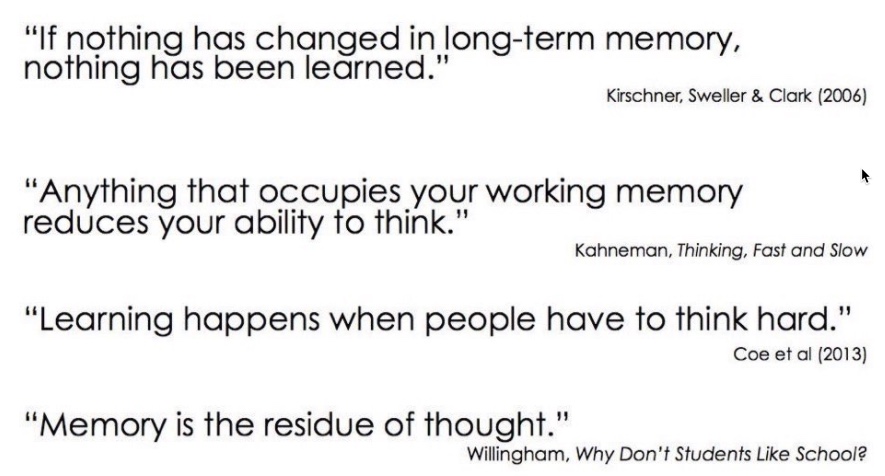
There is one “bottom line” generalization that I think might be useful during discussions of online teaching: thinking matters. There are many different ways to express this idea (I think Willingham’s quote in the image above is my favorite). Cognitive psychology research consistently shows that deep processing (effortful encoding, elaborative encoding, desirable difficulty, semantic encoding, etc.) is necessary for the kinds of long term, transferable learning we are all after. We need to set up learning situations that increase the chances that students will do the kinds of thinking in working memory that they need to do to help move information and skills into long term memory, and be able to recall those information and skills when they need to.
So how do we do this in the context of online instruction? Daisy Christodoulou offers interesting advice in this blog post, but it’s very easy to get lost in the blizzard of suggested websites and apps. If I was a classroom teacher right now, I think I would try to pick a few online tools and try to use them to increase the chances that students are doing the cognitive work they need to do to learn. Here are the tools and steps I think I would think about using (note: the context I’m most familiar with is google classroom, and that’s the tool I would use to “push out” these kinds of learning experiences):
I think my first step would be to take any existing presentation slides I have for upcoming lessons and put blank “reflection slides” in the presentation. I wrote about that idea here.
I would create hyperdocs as a way for students to follow a series of “learning content” “explore” and “try it on your own” steps. I like this Cult of Pedagogy blog post about hyperdocs. I think well designed hyperdocs can help increase the chances that students will do the thinking we need them to do, even when we can’t “be” there.
I would consider changing some of my presentation slides to the Peardeck (or Nearpod) format. These tools allow teachers to embed “check for understanding” slides into existing presentation slides and quickly/easily see student thinking (and use that information to modify future teaching). Both Peardeck and Nearpod are probably more effective ways to accomplish the “reflection thinking” idea I described in step 1 (but it will take more work).
Many other teachers are developing different and possibly better plans than these 3 steps. But I think every effective plan will all share one underlying characteristic: effective online teaching plans will all emphasize student thinking (rather than compliance, amount of work completed, amount of time spent online, effective graphics/videos, effort, etc.) Humans learn what we think deeply about. Memory (and learning) are the residue of thought, whether we are learning face to face or online.
source: https://pxhere.com/en/photo/1428127 – this image is kind of appropriate, and it kind of makes me laugh. The expression on this fellow’s face…
If anyone is looking for a simple “remote teaching” idea, I’d love to talk with you about this simple idea:
take the slides you usually use for a topic/lesson
insert blank slides between all or most of your slides
send the slides as is to students (via google classroom, etc.)
tell the students to use the blank slides as a chance to reflect about what they learned/remember based on the previous slide
I know there are teachers out there who have been doing a great job with online instruction, and many of you are using much cooler and more specialized tools. I think the goals in the list above could be done in more sophisticated ways with tools like PearDeck, or Hyperdocs, or many other tools. But if you need a way to take slides you already have and get some remote teaching done FAST, with little further preparation, I think this idea might work.
Example:
here are some slides I’ve been using with a friend (hi Sarah S!) We use these slides during presentations with teachers. Our goal: help teachers understand how the 3 box model of memory (cognitive load theory) relates to choices we all make during teaching.
during this presentation, we stop at strategic points and ask teachers to talk in groups about how they are understanding the memory theories and how they might use the ideas in their teaching.
since we won’t get to talk with teachers face to face any time soon, we may be able to adapt this same set of slides quickly into a “remote teaching” format.
the goal: make some very quick additions to slides that I already prepared, get them out to folks and give them the opportunity to THINK about ideas in the slides. This thinking will help them make sense of the ideas and connect them with what they already know (semantic encoding).
the next step can be (if you have time) someone looking at what people write on the blank slides, and then following up to correct misconceptions and share great ideas you find. You could simply copy and paste some of what people write on the blank slides and make a new set of slides that includes the best ideas (anonymously or with “credit” to the authors).
I don’t have a classroom, etc. right now so I can’t try this out. If anyone out there wants to talk about this, or use it and tell me what you think, please let me know?
Blake Harvard invited “rebuttals” on his blog recently. This is a very cool idea and will start good conversations, and this blog post is my attempt to participate.
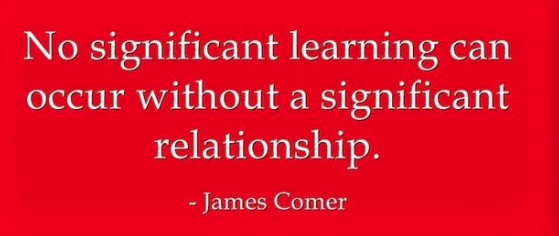
Blake wrote two posts about relationships and teaching/learning. In “But…We Do Learn from People We Don’t Like” he pointed out that we all have examples of learning from people we don’t like, and learning without “relationships”: learning from videos, texts, etc. In “Relationships and Learning: Clarification on a Popular Quote,” Blake researched the popular quote from James Comer in the image above. Blake figured out that Comer used the word “relationships” to refer to “meaningful relationships with material and experiences ” not just teacher-student relationships.
This blog post isn’t really a “rebuttal” of either of Blake’s blog posts, but I want to add to the conversation. I have a personal connection (relationship?) with this topic: my friend Pete and I have been giving a presentation called “Relationships Matter” for a few years. Pete does a great job talking about how positive student-teacher relationships are important for the scholars (Pete’s great word for students) he works with every day. I talk about how classroom assessments impact relationships, and how relationships impact classroom assessment, and how implicit bias complicates all that.
Pete and I use the James Comer quote above. Sometimes we even use this exact image. I appreciate Blake’s research into Dr. Comer’s original intention behind the quote, and I agree with Blake that we can learn from people we don’t like. BUT… relationships are amazingly important in teaching and learning, and I don’t think these clarifications should overshadow that basic truth.
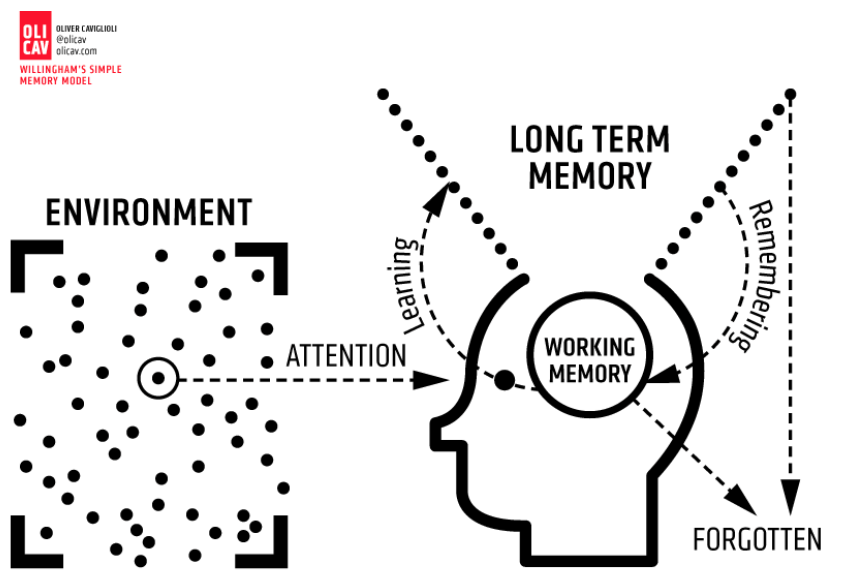
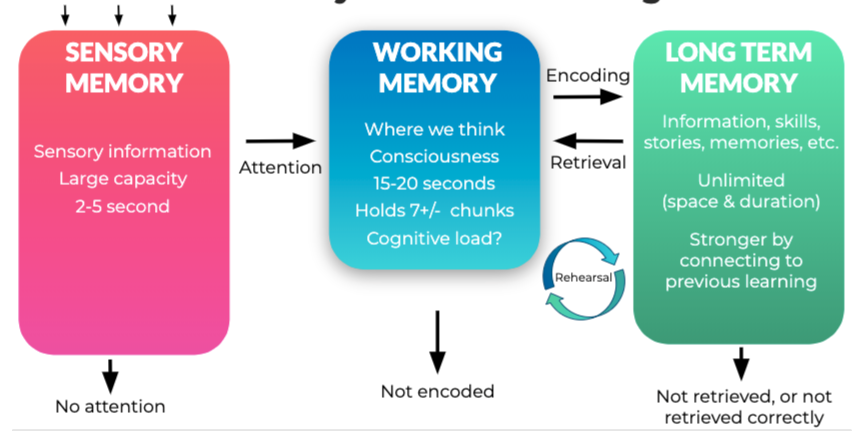
One example: cognitive load theory is one of the most powerful models we have to figure out/predict what we will learn in any teaching/learning situation:
Without going into too much detail about the model (see this blog post for more information) , think about what a powerful student/teacher relationship can influence in the process illustrated above. A positive relationship might increase the chances that:
Attention – students selectively attending to what the teacher is saying/doing
Learning/Encoding – students connecting information/skills in their working memory to something in their long term memory (because the relationship may help teachers and students identify connections between the new information and previously learned information)
Remembering – a strong relationship can help students be more willing to engage in retrieval practice (especially when the retrieval practice is challenging)
There’s a lot more to say about how teacher-student relationships can influence motivational factors. Some of the relevant motivation findings are summarized in the APA’s Top 20 document. Cognitive psychology research has a lot to teach us about learning, but so does motivation theory, etc. So I think I agree with Blake, but disagree slightly in an important way: Dr. Comer may have meant something different when he originated this quote, and it’s true that we can learn from people we don’t like. BUT relationships absolutely matter! They influence student attention, encoding, remembering, motivations, emotions, self-efficacy, and dozens of other factors that influence what students learn.
(for the record: I strongly suspect that Blake knows all this already. I bet he’s a great teacher who develops strong, positive relationships with his students)
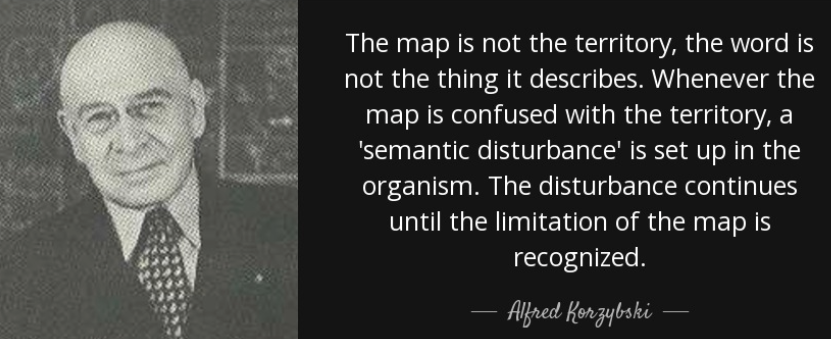
We have a LOT of terms in education-land. The great Stephen Chew wrote effectively about this (“Teaching and Learning: Lost in a Buzzword Wasteland“) , and I agree with him: we may have so many words for teaching and learning that it’s easy to get lost in the territory because the map is cluttered with terms.
So I have some mixed feelings about this wonderful blog post by Elham Arabi: “The Impact of Guided Discovery vs. Didactic Instruction on Learning.” I love the ideas Arabi discusses in the blog post: she’s describing fascinating research about the relationships between providing direct instruction and allowing students to explore problems on their own. This is an important topic, and the research is relevant to decisions teachers make in classrooms daily.
In the blog post, Arabi provides a careful summary of several studies about this topic, and then concludes “if you want your learners to apply what they have learned to different contexts, guided discovery may be a better approach. Results of these two studies showed that learners may become dependent on concept or problem without recognizing its applicability when they receive direct instruction. In such instances, didactic teaching may limit learners’ understanding of deep structure of a concept, whereas guided discovery may result in better learning retention and transfer.” This is a REALLY important idea: if we want students to be able to transfer what they learn (and we all do!), then we need to provide structured, supported opportunities so that students can figure things out on their own. They need enough “guides” (background knowledge and practice) so that they can make useful progress toward solutions, but not so much “direct instruction” that they are just following rote set of instructions without reflecting and understanding what they are doing. We need to hit the sweet spot, the butter zone between support and exploration.
That’s all important, and gets to part of the heart of effective teaching and learning, I think. Teachers are, and always will be, working to hit that sweet spot for students. It’s tricky, never-ending work. We try, we succeed sometimes, we fail other times, we make changes, and we tray again and again. The research Arabi describes can help us as we try and try again.
But I worry about getting lost in the buzzword wasteland. Arabi points out that “guided discovery should not be mistaken with discovery learning.” She goes on to describe what she means, but do these new terms on the map help us navigate this tricky territory? Do I need to go back through the research/writings I use when I think about what kinds of instruction to provide before letting students take a swing at their own answers to important questions? Do I need to worry about whether I’m reading about guided discovery, discovery learning, inquiry based learning, student centered learning, active learning, etc etc etc? I’m not sure the proliferation of labels in this area of research are helping us think more clearly. I think I agree with Stephen Chew when he says that we may need to “develop a comprehensive theory of how people learn” instead of focusing on fine distinctions between terms like “guided discovery” and “discovery learning.” Instead of worrying about which term is most appropriate, let’s focus on the underlying cognitive psychology that’s going on during teaching that encourages long-term transfer. The word may not be the thing – we’re all interested in real learning, not what the best words are to describe real learning.
I’ve been thinking about the “best” way to help students use cognitive science (3 box model/cognitive load model) to make decisions about how they study. There’s great advice out there for students about how to study:
BUT in my (limited) experience so far, many students aren’t “convinced” by these kinds of organized presentations of research-based advice. What would convince them?
Here’s one thought (and I haven’t tried it yet): if students could make a their own personalized model of memory, could they use that customized model to make small changes in their behavior? I’ve been sharing a lesson plan called “Sketch Your Memory” with teachers and so far teachers say they find it useful, but I don’t know if students will respond to it.
I wonder if we help students get some background knowledge about the 3 box memory model/cognitive load theory, would it be helpful if they then go on to make their own graphic of the model? The graphic might include some of the basic terminology from the background knowledge, AND students customize their model with examples (maybe in a different color?) of actions they already take or could take to “enact” that part of the model.
Example: after a student fills in “deep processing” as a term related to encoding (in the encoding arrow between working and long term memory), they could fill in their plan for deep processing (“For every vocab term I have to learn, I’ll write in a quick example from my life that relates to the vocab word.”)
I’d love to hear your thoughts: would a personalized 3 box memory model like this help students motivate themselves to change their studying?
Last week at work I ended up in conversations with a colleague and couple curriculum specialists, and those conversations helped us figure out that we didn’t know the answer to what seems like kind of a basic question that involves cognitive psychology and reading comprehension. I decided to send the question to some cognitive psych folks (from the CogSciSci group), and the responses were fascinating.
Here’s the question we asked:
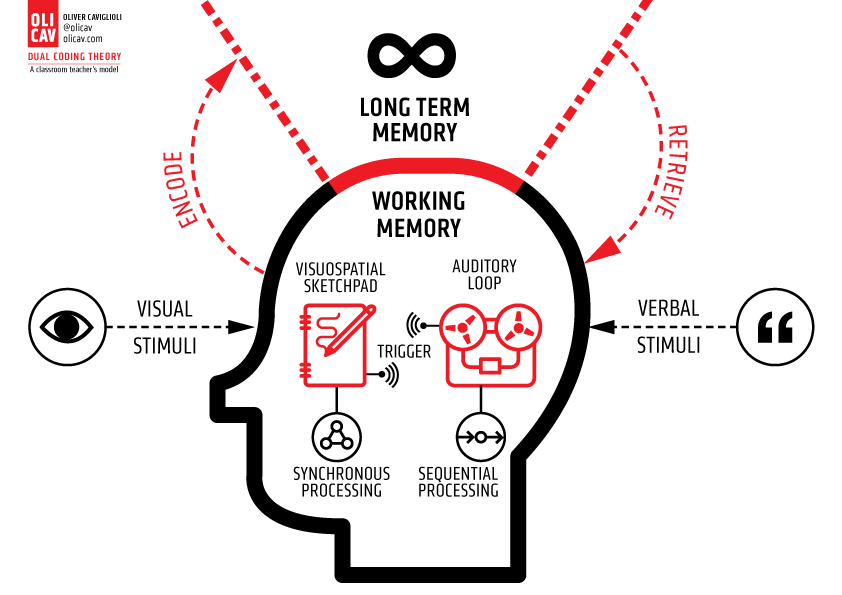
Question: which of the following scenarios would dual coding/working memory/cognitive load theory predict might be more useful?
Scenario A: students listen to audio of their teacher reading a passage WHILE the students look at the passage, then answer reading comprehension questions about the passage (students process the audio and printed text in their working memories at the same time)
Scenario B: students listen to audio of their teacher reading a passage THEN they look at the passage on their own, then answer reading comprehension questions about the passage (students process the audio in their working memories and then the text)
This seems like kind of a basic issue, right? If a teacher is going to read out loud to students, should the students have a copy of that text and read along with the teacher, or should the students listen first and then try to read the passage?
The cognitive psychologists we consulted surprised us: they immediately replied and they all agreed that cognitive load theory predicts that Scenario B is most likely to work the best. A couple quotes from their responses:
“Scenario A would run the risk of the Redundancy Effect (both sources of info using phonological loop).”
“Scenario B is better from a purely CLT perspective. Its also better as the students get two exposures to the content instead of one. In the real world there might be reasons that A is preferred like time constraints or the importance of linking the words spoken to their written words, like pronunciation”
And one of our cognitive psych friends referenced this thorough and fascinating blog post from David Didau: “The Problem with ‘Reading Along'” (bonus: this blog post manages to reference a 4th century bishop AND farting!)
I love that cognitive psych (specifically Cognitive Load Theory – CLT) can point us in the right direction about many of these “basic” questions about pedagogical choices. When we’re reading out loud, we should think about what our goals are (reading comprehension, or linking spoken works to written words), and use CLT to figure out whether students should read along with us or listen first and then read it on their own.
I stumbled across this wonderful article by Claire Sealy at just the right time. I’ve been thinking about semantic vs. episodic encoding and how it might fit into some conversations with teachers.
“All of which leads to us making the entirely reasonable hypothesis that if we want students to remember what we teach them, then we need to … involve something specially selected because it’s exciting and possibly unusual. Memorable events, in this view, should form the template for creating memorable lessons.”
I remember this exact feeling as a young teacher. The “teacher as hero” movies (Mr. Holland’s opus, Stand and Deliver, Dead Poet’s Society, etc.) taught many of us that the best teachers inspire students through drama and passion. Setting up exceptional experiences for students is one of the most satisfying parts of teaching, and I love crafting a dramatic experience for students (and it can definitely help with motivation and “hooking” students). But Sealy goes on to explain some limitations of these dramatic “memorable lessons.”
“The two forms of memory are known as episodic and semantic memory. Episodic memory is the memory of the ‘episodes’ of our life—our autobiographical memory. This takes no effort on our part, it simply happens…Those memories just happen automatically. But there is a downside. Episodic memory is “easy come, easy go.” … A Semantic memory, on the other hand, involves much harder work. We have to expend effort to create semantic memories. This is the kind of memory we use when we consciously study something because we want to remember it. Unlike episodic memory, it does not just happen. The upside, however, is that the effort involved results in a long lasting memory.”
This important difference between Semantic and Episodic memory is something every teacher (and administrator, and instructional coach, and curriculum/instruction director, and assessment developer, etc.) should know and use in their work. If our goal is long-lasting learning – knowledge and skills that students will be able to use in different contexts in the future – then we need to set up learning experiences that help students semantically encode rather than just episodically encode. In some ways “long-term transfer” is the holy grail of our work: we want students to be able to generalize the knowledge and skills they learn and apply them to answer important questions in their lives. That requires semantic memory, not just episodic memory. When I need to figure out how to best think about the relationships between achievement data from local schools and statewide data, it doesn’t do me any good to remember the fantastic, funny story my stats teacher told me. I need to be able to recall the meaning of group comparisons and determine what kinds of analyses are appropriate.
This one, fairly simple understanding – that the goal of our lessons should be to help students semantically encode rather than episodically encode – should influence the choices we make as teachers.
“Forming semantic memories requires work and practice. Unlike episodic memories, they don’t just happen. If you want to remember something, you need to think about it, not just experience it. The cognitive psychologist Daniel Willingham explains that ‘memory is the residue of thought.’ The more you have thought about something, the more likely it is that you will remember it. So teachers have to make sure that lessons give students the opportunity to think the things we actually want them to remember, rather than some extraneous other thing… This is where “fun” lessons can unintentionally prevent learning happening. If the medium chosen to deliver the lesson is too obtrusive, it is that the students will think about, rather than whatever it is we actually want them to learn”
I took a swing at summarizing what I think is the most important implication of cognitive load theory for teachers, and I tried to do it in one sentence: “What students do in their working memory determines what they will remember and recall later.” I’m sure there are limitations to that short summary, but I think it’s true in some important ways. Thinking about lessons through the lens of semantic/episodic memory should help remind us that our goal is to get students doing SEMANTIC thinking in their working memory, rather than episodic encoding. If what we’re doing doesn’t help students encode the meaning/utility/applications/etc. of the topic at hand, we’re probably engaging in a “Grecian Urn” project. They may be having fun and they may remember the story, but they aren’t thinking about what it all means and it won’t transfer to future thinking.
“It is also possible to overstate the separateness of episodic and semantic memory. There is a degree of overlap between the two. They are not water-tight compartments. For example, in one experiment, people were asked to list kitchen utensils. First, participants drew on the contents of their semantic memory, but when that ran out they turned to thinking specifically about their own kitchens and remembering what was there. They augmented their recall from semantic memory with context-specific episodic memories.”
I appreciate that Sealy acknowledges the “overlap.” I think there is (or can be) opportunities for teachers to use episodic encoding as a bridge to help students understanding meaning (semantic encoding). Sealy’s example highlights this, and many great teachers use the power of stories to help students think about meaning and application. But we have to make sure we leave time for that connection: it is very tempting to spend all our time on the fun, engaging story and believe that students glean meaning from that activity or story. They probably won’t unless we deliberately create ways for them to think about the meaning of what they heard or were doing, and practice applying those meanings.
“It is not a simple binary choice between always only doing one or the other. Nor is it the case that episodic memory is in some way “bad” or inferior. It’s just different. The deliberate building of semantic memory is much more likely to result in long lasting, flexible and transferable memory than putting most of your energies into the episodic basket, so should form the bulk of what we spend our time on.”
This is where Sealy ends her article, and this may be the most important punchline. As teachers we’re not choosing between good and bad, semantic and episodic, etc. We know that our goal is for students to encode knowledge and skills that they can apply in future situations, which means that they need tasks that encourage them to do thinking in their working memories that encourage semantic encoding. And stories, activities, and simulations that students will remember help hook students and motivate them to engage in the deep processing they need to do in order to semantically encode.
UPDATE (Dec. 2020): this post – “TWO NEW WAYS OF THINKING ABOUT MEMORY” by @learningandtheb and @AndrewWatsonTTB helps me think about this idea – “that the goal of our lessons should be to help students semantically encode rather than episodically encode” – in a different way. Andrew points out that “episodic memories gradually turn into semantic memories: general knowledge of abstract facts.” So my thinking may have been a bit off in this blog post: as teachers, we don’t want to AVOID teacher moves that encourage episodic encoding. It may be a better idea (and more realistic) to think about what teacher moves we can make that might help students turn episodic memories into semantic memories (as Andrew says: “we want our students to semanticize most of their learning.”)
During a meeting last week, someone repeated the phrase “What gets measured gets taught.” Many people in the meeting nodded along, indicating their agreement with this currently-accepted truth about teaching and schools. My guess is that the intent of this phrase is to emphasize the importance of assessment, and to acknowledge that curriculum areas, standards, etc. that are included in large-scale assessments get more emphasis in classrooms.
There’s some truth in that. The curriculum area I work with most often, Social Studies, isn’t included in our end of year statewide test (thank goodness – I don’t think there’s a great way to assess a lot of what needs to happen in social studies classes on a large-scale test). Because social studies isn’t included in the statewide exam, the number of minutes spent on social studies instruction in many districts has gone down over time. So in this sense, “what gets taught” got influenced by “what is tested.” Most teachers and administrators I know regret this impact. I’m glad that my school district has resisted this trend more than many other districts, and we should all resist this trend. Large-scale testing can’t include many, many important learning goals (and entire curriculum areas), and districts should try to resist letting the end of year test have an inappropriately loud voice in discussions about what students need to learn.
There’s another (more grim and depressing) way to interpret the phrase “what gets measured gets taught.” I fear some people interpret the phrase to mean “If you can’t measure it, it doesn’t belong in your classroom.” This interpretation leads to outcomes none of us want, I suspect. Think about everything you want to learn, and you want your kids to learn, that we can’t measure well. Think about your most important teachers and what you learned from them. Think about the kind of teachers and classrooms you want for your kids or the other young people you know and love. Think about what you learned with your favorite teachers, and what you want other students to learn. How much of all that “got measured?” How much can be measured? Many important learning goals can be “measured”: feedback about the quality of your writing, speaking, and thinking is important and helps us get better. But I bet you can think of many, many examples of learning that can’t be measured. You want classrooms to be inspiring, to help make sense of our inner world, to help us uncover important truths about ourselves. I hope you experienced moments of revelation in a class with a favorite teacher. And I bet that didn’t get measured.
Assessment, feedback, and evaluation can be a useful (maybe even vital) part of teaching and learning. But some of the most interactions and events in classrooms can’t (and shouldn’t) be measured. The next time you hear someone say “what gets measured gets taught,” you may want to talk with that person about what they mean. In the end, I bet none of us want the goals of classrooms to be restricted to only measurable experiences.
It seems like there is a bit of a mini-explosion right now about cognitive psychology and teaching/learning. There are so many great resources that it’s kind of hard to keep up! Here’s a slide I’m trying to maintain with links to some of my favorites:
BUT it’s possible (likely!) that most teachers and students don’t have a bunch of extra time to read these fantastic resources. Fortunately, there are two video resources that can provide a quick and useful introduction to many of the most useful concepts from cognitive psychology for teachers and students:
Steve Chew’s fantastic “How to Study” videos are popular for a good reason: Steve clearly and concisely explains how cognitive psychology concepts can help students study more effectively. Teachers can use these same concepts to make more effective lectures and lessons. Watch this series of 5 videos and you’ll know most of the most important concepts in the science of learning: How to Get the Most out of Studying
The good folks at Crash Course developed a similar set of videos, and they are great! The production values on the crash course videos are a lot higher than Dr. Chew’s, but both series provide a great introduction: Crash Course Study Skills: Memory
Identify basic concepts and research findings, and give examples of psychology’s integrative themes. ~ Psychological science relies on empirical evidence adapting as new data develop. ~ Psychology explains general principles that govern behavior, while recognizing individual differences. ~ Psychological, biological, social, and cultural factors influence mental processes and behavior. ~ Our perceptions filter experience of the world through an imperfect personal lens. ~ Applying psychological principles can change our lives in positive ways.
Rob thoughts: I think I love the “integrative themes.” It will be REALLY interesting to see how these themes play out in an AP course. I bet textbook authors could have a lot of fun integrating them into different units. And if College Board wants to change the writing tasks on the AP Psychology test into something different, these themes could be used to develop great writing prompts.
I’m a little confused by the first statement “Identify basic concepts and research findings, and give examples of psychology’s integrative themes.” Both parts of that sentence make sense, but I’m confused about why they are smooshed together? I’m thinking of them as two separate SLOs – one about identifying content, and one about giving examples of integrative themes. Is that how you think about it? Am I missing something?
Apply psychological principles to everyday life. Rob thoughts: Love it! Always been one of the goals of every great AP and Introductory Psych teacher and one of the best things about our class.
Draw appropriate, logical, and objective conclusions about behavior and mental processes from empirical evidence. Rob thoughts: This seems like the “research methods” SLO to me, and I think that’s a good idea. I like the phrasing – “appropriate, logical, and objective” are a great way to express the scientific world view. Nice!
Evaluate misconceptions or erroneous behavioral claims based on evidence from psychological science. Rob thoughts: This one feels like connected to (or an extension of, maybe?) the skill described above. I like the inclusion of the idea of that students should be able to draw appropriate conclusions AND spot bad/unsupported conclusions when they see them. Maybe the writing tasks on the AP Psychology test could evolve into one essay about one or more of the integrative themes, and the other one could be about drawing conclusions from research and/or critiquing conclusions with flaws. Hmm.
Design, conduct, or evaluate basic psychological research. Rob thoughts: The first part of this skill makes total sense to me. Designing and conducting research is very different from the previous SLOs. But the “evaluate” part seems really similar to the two SLOs above? There’s a lot of overlap, right?
Describe ethical principles that guide psychologists in research and therapy. Rob thoughts: Sounds like a good idea. Nice way to combine thinking about the experimental and clinical worlds of psychology. This one seems “smaller” than the others, maybe?